An Halloween verstarb heute vor 88 Jahren der bis dahin wohl erfolgreichste PR- und Entfesselungskünstler Houdini. Zur Pflege seiner Legende zu Lebzeiten bemühte er auch die Gerichte, so etwa 1902 das Schöffengericht Köln (heute wäre die Zivilkammer 28 des Landgerichts zuständig). Houdini hatte einen Preis für denjenigen ausgelobt, der ihn tatsächlich fesseln könne. Der Schutzmann Graf hatte Houdini mit einem manipulierten Schloss gefesselt, das nicht mehr konventionell zu öffnen war. Darüber hatte ein Redakteur der Rheinischen Zeitung genüsslich berichtet und behauptet, Houdini habe versucht, sich mit Fesselern abzusprechen.
Das ließ sich der ehrbare Handschellenbezwinger nicht bieten und brachte beide vor Gericht. Im Gerichtssaal bewies er hinter dem Richtertisch unter den Augen von Richtern und Schöffen, dass er sich aus dem fraglichen (nicht manipulierten) Schloss befreien konnte. Der Schutzmann erhielt eine Strafe von 200 Mark, der Journalist musste 20 Mark zahlen.
Obgleich der Schutzmann weder dienstlich handelte noch einen hohen Rang bekleidete, stellte Houdini die Sache so dar, als habe er es in Köln mit der kaiserlichen Polizei aufgenommen.
In einem anderen Verfahren sollte Houdini seine Künste beweisen, in dem er den Tresor eines Gerichtsdirektors ohne Schlüssel öffnete. Zwar war Houdini tatsächlich ein Meister im Schlösserknacken, hier allerdings war es besonders einfach: Die Tresor-Tür war nicht einmal ins Schloss gefallen …
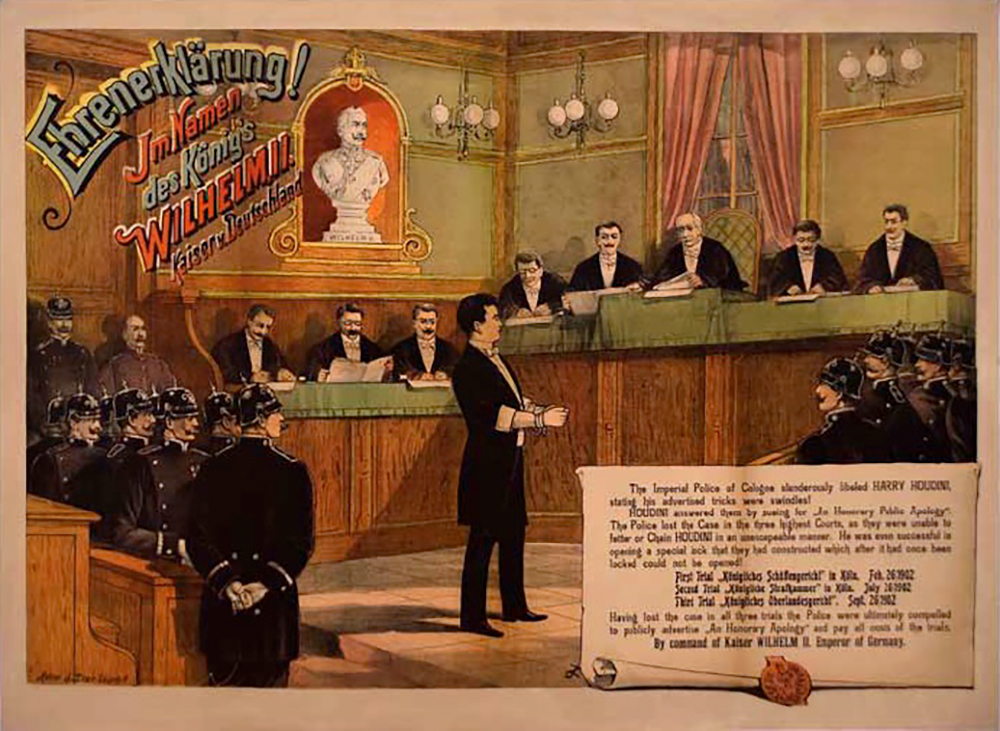
[Text in illustration: The Imperial Police of Cologne slanderously libeled HARRY HOUDINI, stating his advertised tricks were swindles!
HOUDINI answered them by sueing for „An Honorary Public Apology“. The Police lost the Case in the three highest Courts, as they were unable to fetter or Chain HOUDINI in an unescapeable manner. He was even successful in opening a special lock that they had constructed which after it had once been locked could not be opened!
- First Trial „Königliches Schöffengericht“ in Köln. Feb. 26 1902
- Second Trial „Königliche Strafkammer“ in Köln. July 26 1902
- Third Trial „Königliches Oberlandesgericht“. Sept. 26, 1902
Having lost the case in all three trials the Police were ultimately compelled to publicly advertise „An Honorary Apology“ and pay all costs of the trials.
By command of Kaiser WILHELM II. Emperor of Germany.]
The Royal Schöffengericht, the third „Ferienstrafkammer,“ found Werner Graff guilty of slandering Houdini, and the Oberlandesgericht Court also find that the Royal Schöffengericht was justified in finding Graff guilty of the charges. Werner Graff is guilty of „Openly Slandering“ Houdini, for being the chief instigator of the article which he caused to be inserted in the Rheinische Zeitung July 25, 1901, number of edition 170, and the head-lines which read „Houdini, the world-famous Handcuff Releaser.“ Being found guilty of the above charge, Werner Graff is fined 30 marks in money, and should he fail to pay the sum fine, he will serve a day in prison for every 5 marks; and is also fined to pay all costs of the three trials.
Houdini has the right to publish the verdict one time in the Cologne newspapers at the cost of Schutzman Werner Graff.
For the rightful writing of this verdict, we sign as responsibilities, Coln, Oct. 24, 1902. Stock Sekretar.
Gerichtsschreiber des Kgl. Amtsgericht Abtlg VI.—9.
According to The Great Houdini Handcuffs and Legirons:
These are the cuffs [lock?] that Houdini had to open during his trial in Klon, Germany, February 19, 1902 [July 26, 1902]. After Houdini escaped he handed them to the judge. One of Houdini’s assistants, Franz Kukol, managed to get hold of them and passed them back to Houdini who fleeced them out of the court room. Kaiser Bill’s best policemen never knew what became of them. The cuffs got locked again in all of the excitement and have never been opened since. Houdini said there was not another set like these in the world because the Supreme Court of Germany had these custom built for the trial.
Is the German Berliner Handcuffs really the “special lock” that got built [used] for the trial on July 26, 1902, that after it was once locked, no key would open it?
The story of the trial(s) appears in The Adventurous Life of a Versatile Artist – Houdini. Below is the text:
OFFICIAL POLICE NEWS FROM GERMANY!
HARRY HOUDINI, THE AMERICAN HANDCUFF KING, SUES
THE COLOGNE POLICE FOR LIBEL, AND WINS! ! !
A Condensed History of the Lawsuit Against the Cologne Police!
The police of Germany are very strict in matters of false billing or misrepresenting exhibitions to the public, and the case of the well-known Dr. Slade, also a well-known American ” thaumaturgic” performer, as also an equally familiar “magnetic ” woman, and several others who have clashed with the German police will probably also call in mind the latest case of the flower medium, Mrs. Rothe, who was sentenced to two years in prison and 500 marks fine.
What for? Well, she deceived the public in telling them that she could obtain communications from the spirit world.
This the police claim was obtaining money under false pretense, and there you are.
The Cologne police claimed that Houdini was also traveling about misrepresenting, and that all he did was “swindle.” The chief one was Schutzmann Werner Graff, who openly published a false story in the Rheinische Zeitung, which put Houdini in a very bad light, and, as a man of honor, Houdini could not overlook the insult.
He claimed that he had been slandered, and asked an apology, also a retraction of the false stories, which all the press of Germany had copied; but was simply laughed at for his trouble.
Engaging the best lawyer of Cologne, Herr Rechtsantwalt Dr. Schreiber, Louisenstrasse 17, this able lawyer defended Houdini in all three instances.
The first trial occurred in Cologne, Feb. 19, 1902; in this trial Houdini charged the Schutzman Werner Graff for publicly slandering him, whereupon, as answer, Herr Graff told the judge and jury that he was willing to prove that Houdini was misrepresenting, that he could chain Houdini so that he could not release himself. Houdini permitted himself to be chained by Herr Transport Police Lott, and to show how easy it was he willfully showed to the judge and jury how he opened [“escaped”] the chain and [“opened”] lock. [Note: “Escaping” the chain and “opening” the lock were two separate demonstrations during the first trial according to Silverman]
After a four days’ trial, Houdini won the lawsuit, and the Cologne police were fined, and were to publicly apologize to Houdini, “In the Name of the Kaiser.”
Instead of so doing, they took it to the higher court, ” Strafkammer” [where again the court put Houdini to the test of opening one of Graff’s prepared locks]. At this trial they had specially manufactured a lock, which was made by Master Mechanic Kroch, a lock that when once locked nothing would open it; even the key could not open the lock.
The police asked that Houdini should show his ability by opening this lock after it had once been locked.
The following is a free translation of what the press had to say at the second trial.
In the highest court (Strafkammer zu Koln Yuli 26, 1902) [July 26, 1902] Police Officer Werner Graf! Was found guilty of Slandering Harry Houdini, heavily fined, he must pay all costs, and insert an advertisement in all of the Cologne newspapers, proclaiming his punishment, at the same time, ” IN THE NAME OF THE KING,” openly apologize to Houdini for insulting him.
This open apology is the severest punishment that can be given to a royal official, and as the lawsuit has been running over a year, the costs will run into the thousands of marks.
The case was first tried in the Schoffengericht Koln, Feb, 19, 1902, and Werner Graff was found guilty, but he took it to the highest court, and again Houdini won.
The Cologne police claimed that all Houdini advertised to do was misrepresentation (this was the cause of the lawsuit); for the trial they had a special lock made that, after it was once locked, no key would open it.
This lock they challenged Houdini to open, to prove that he was not misrepresenting.
Houdini accepts the challenge, walks into the room selected by the jury where he could work unhindered. In four minutes, with a quiet smile, reenters the court room, and hands the judges the prepared lock opened.
Among the thirty police officials that testified against Houdini were some of the highest officials of Cologne, but Houdini won; in fact, he was “one ” too many for them.
It being a disgrace for Schutzman Werner Graff to have this punishment on him, with the assistance of the police, he took it to the highest court in Germany, ” Oberlandesgericht, ” and there [Third Trial] the learned judges again gave Houdini the verdict from which there is no appeal.
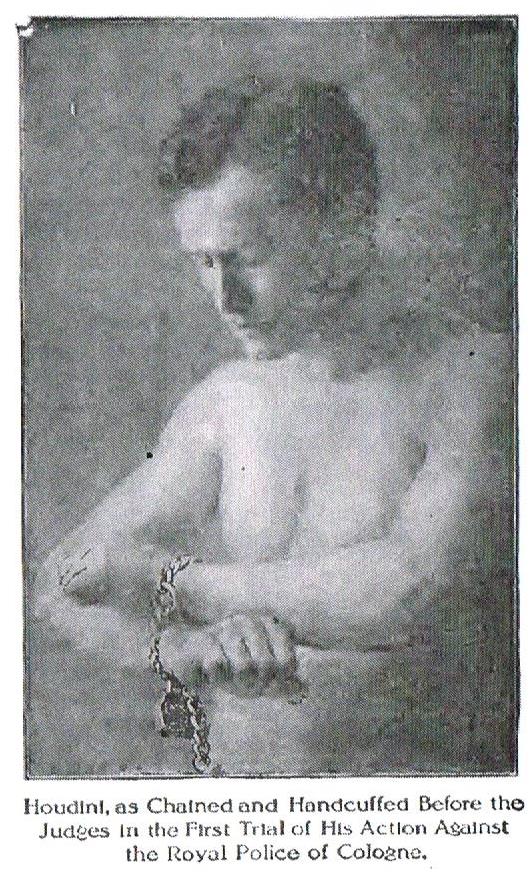
 According to Kalush:
One of the Cologne papers covering the sensational trial indicated that Houdini “had brought an entire suitcase filled with cuffs and locks and made all sorts of experiments to prove his skill.”
…
On March 1, 1902 Houdini wrote Bard again to crow about the verdict. “I win my case hands down… [Graff] swore to a whole pack of lies, and when the other witness [Lott] came in, why I made him look like a dummy, and he gave the whole plot away.” After some self-righteous indignation over his honor, Houdini admitted how he came out on top. “What really saved my cas[e], was that I showed the judge how I opened my cuffs, and that was really the best thing that I could have done.”
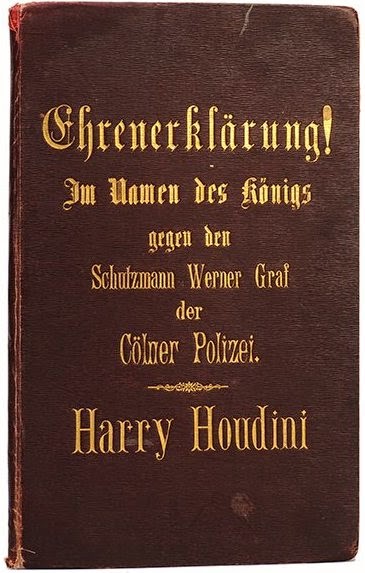 According to a snippet of the Aug 23, 2014 Potter and Potter auction description for Houdini’s German Slander Trial Archive, 1902 (sold for $26,000):
“These reproduce the handwritten account and detail the proceedings, which included escapes by Houdini from locks and chains, as well as a demonstration of how to escape handcuffs.”
So I will ask the question again:
Is the German Berliner Handcuffs really the special lock that got built [used] for the trial on July 26, 1902, that after it was once locked, no key would open it?
Or could the German Berliner Handcuffs be a Houdini creation?
According to a comment on Handcuffs.org regarding some thoughts on the Houdini Berliner:
I was at one of the Cannon Conventions and got to handle the cuff. We are talking about the Houdini cuff. There is a magazine called the Virginia State Trooper (or close to that) and Hardeen was interviewed. I believe this is 1949. In the discussion, Hardeen asked Houdini what is the cuff and why does it not have a key? Houdini replies, this is the only cuff like it in the world and I had to pick it open in the court room in Cologne in front of the judge. This quote is not perfectly quoted and is from memory. I can quote this accurately if desired. At some time after this went to press a key was made for these cuffs [and it worked perfectly].
Next week we will explore the third trial.